SEO
What Moves a Giant's Rankings? Nike Rank Watch
A live experiment tracking nike.com on 10 Google keywords every week since May. Brand terms held; the losses came from generic terms and weeks when Google ranked the wrong Nike page.
Year :
2026
Industry :
Sportswear e‑commerce
Client :
Independent SEO experiment
Project Duration :
Ongoing, since May 2026

The experiment
Nike is the biggest brand in sports retail search. I wanted to see what actually moves a giant’s rankings from week to week, so I have tracked nike.com on ten Google keywords every week since May. This is SEO Lab #02, and the experiment is still running.
Why I started this
In January 2026, a niche sports brand asked me to do keyword research and on-page optimisation for them. I didn’t have the time to take it on then due to other projects, but it made me want to understand how rankings behave over time, not just in a one-off snapshot. So once I was free, I set up weekly tracking on one of the most searched-for brands in the sports world and watched what moved.
Setup
Site: nike.com. Keywords: ten terms, mostly brand and product names like “jordan”, “jordan 4” and “air force 1”, plus generic terms like “basketball shoes”, “soccer cleats” and “shoes”.
Search: Google US, desktop. Period: weekly since 5 May 2026, with 22 snapshots at the first write-up on 29 September. Tool: SEMrush Position Tracking.
Live tracker
This report updates every week with the latest SEMrush check. Use the filter above the table to switch between brand and generic keywords, and the change column to see which keywords moved since last week.
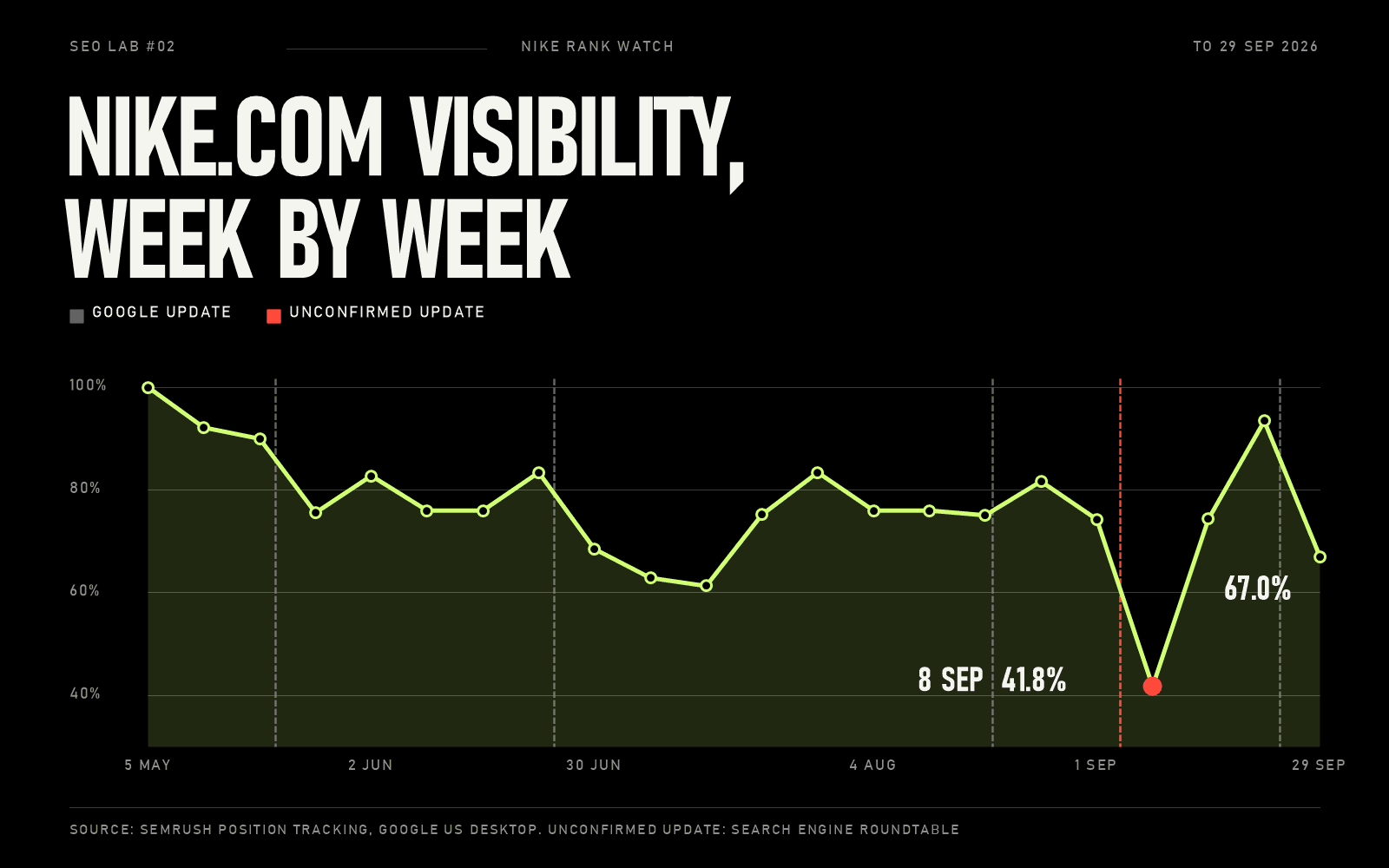
Visibility fell from 100% to 67% (to 29 September)
SEMrush Visibility scores how close a site sits to the top for the tracked keywords: 100% means every keyword ranks #1. Nike started at 100%, hit its low of 41.8% on 8 September, recovered the next week, then fell again at the end of the month.
What the data shows
The findings below come from the first write-up on 29 September 2026. The live tracker above has the latest numbers, and new findings get added to the update log below.
Brand terms hold; generic terms carry the risk
“jordans” held #1 in all 22 weeks. “jordan 11”, “air force 1” and “basketball shoes” held it in 20 or 21. The generic terms were the unstable ones: “soccer cleats” swung between #1 and #9 before dropping out of the top 100, and “shoes” was missing most of the time. Google updates explain part of it: the May core update lines up with a dip, and the September crash lines up with an unconfirmed update. The loss on “shoes” and “soccer cleats” built up over months instead.
Nike has no stable page for “shoes”
“shoes” is the biggest term tracked, with 550,000 searches a month and the highest cost per click in the set. Nike ranked for it in only 6 of 22 weeks, and Google chose a different page almost every time: a sale page, the Nike By You customiser, a Luxembourg kids’ shoe, and finally single product pages. What I’d do: give “shoes” one clear owner, a well-linked all-shoes category page, so Google stops guessing.
The 8 September crash matched an unannounced Google update
Visibility dropped to 41.8% in one week. SEMrush showed no Google update then, because it only marks updates Google announces. But Search Engine Roundtable reported an unconfirmed update that hit large sites around 4 September and reversed on 13 September. Nike’s drop and its recovery by 15 September line up with both dates.
The data shows how it reached Nike: for “jordan” (#1 to #21) the Air Jordan collection page replaced the /jordan hub, and for “jordan 4” (#1 to #8) a Jordan football boots page ranked for a sneaker search. Then Google switched back. Official update lists are not enough to explain a drop: check the dates against industry reporting too.
Other countries’ pages are showing up in US results
I noticed something odd. On 29 September a Canadian page ranked for “jordan 4s” in the US, and the keyword fell from #1 to #8. On 8 September a Luxembourg page ranked for “shoes”. Nike runs dozens of country versions, and hreflang tags are how it tells Google which one to show where. These cases suggest those signals don’t always win.


What I'm doing next
This experiment keeps running, and each update gets added here.
Add competitors: track adidas and Puma on the same keywords, to see who gains when Nike drops, especially on “soccer cleats”.
Add more generic terms: the set leans on Jordan. Adding terms like “running shoes” and “sneakers” will test whether the “shoes” pattern repeats.
Log URL swaps: record every week Google switches Nike’s ranking page, and whether position drops with it.
Update log
29 September 2026: first write-up, 22 weekly snapshots analysed.
October 2026 onwards: new weeks added to the live tracker every Wednesday.
Limits
Ten keywords, weighted toward Jordan terms: the results describe these terms, not all of nike.com. Visibility is a SEMrush estimate based on position, not real traffic. Weekly checks can miss short moves between snapshots. No competitors were tracked yet, so this shows when Nike moved but not who took its place.
An independent project using public SEMrush data only. No internal company data was used.
Sources: SEMrush Position Tracking (rankings, visibility, confirmed Google updates); Search Engine Roundtable, “Google Search Ranking Update Around September 4th That Reverted September 13th” (unconfirmed September update).
More Projects


SEO
What Moves a Giant's Rankings? Nike Rank Watch
A live experiment tracking nike.com on 10 Google keywords every week since May. Brand terms held; the losses came from generic terms and weeks when Google ranked the wrong Nike page.
Year :
2026
Industry :
Sportswear e‑commerce
Client :
Independent SEO experiment
Project Duration :
Ongoing, since May 2026
The experiment
Nike is the biggest brand in sports retail search. I wanted to see what actually moves a giant’s rankings from week to week, so I have tracked nike.com on ten Google keywords every week since May. This is SEO Lab #02, and the experiment is still running.
Why I started this
In January 2026, a niche sports brand asked me to do keyword research and on-page optimisation for them. I didn’t have the time to take it on then due to other projects, but it made me want to understand how rankings behave over time, not just in a one-off snapshot. So once I was free, I set up weekly tracking on one of the most searched-for brands in the sports world and watched what moved.
Setup
Site: nike.com. Keywords: ten terms, mostly brand and product names like “jordan”, “jordan 4” and “air force 1”, plus generic terms like “basketball shoes”, “soccer cleats” and “shoes”.
Search: Google US, desktop. Period: weekly since 5 May 2026, with 22 snapshots at the first write-up on 29 September. Tool: SEMrush Position Tracking.
Live tracker
This report updates every week with the latest SEMrush check. Use the filter above the table to switch between brand and generic keywords, and the change column to see which keywords moved since last week.
Visibility fell from 100% to 67% (to 29 September)
SEMrush Visibility scores how close a site sits to the top for the tracked keywords: 100% means every keyword ranks #1. Nike started at 100%, hit its low of 41.8% on 8 September, recovered the next week, then fell again at the end of the month.
What the data shows
The findings below come from the first write-up on 29 September 2026. The live tracker above has the latest numbers, and new findings get added to the update log below.
Brand terms hold; generic terms carry the risk
“jordans” held #1 in all 22 weeks. “jordan 11”, “air force 1” and “basketball shoes” held it in 20 or 21. The generic terms were the unstable ones: “soccer cleats” swung between #1 and #9 before dropping out of the top 100, and “shoes” was missing most of the time. Google updates explain part of it: the May core update lines up with a dip, and the September crash lines up with an unconfirmed update. The loss on “shoes” and “soccer cleats” built up over months instead.
Nike has no stable page for “shoes”
“shoes” is the biggest term tracked, with 550,000 searches a month and the highest cost per click in the set. Nike ranked for it in only 6 of 22 weeks, and Google chose a different page almost every time: a sale page, the Nike By You customiser, a Luxembourg kids’ shoe, and finally single product pages. What I’d do: give “shoes” one clear owner, a well-linked all-shoes category page, so Google stops guessing.
The 8 September crash matched an unannounced Google update
Visibility dropped to 41.8% in one week. SEMrush showed no Google update then, because it only marks updates Google announces. But Search Engine Roundtable reported an unconfirmed update that hit large sites around 4 September and reversed on 13 September. Nike’s drop and its recovery by 15 September line up with both dates.
The data shows how it reached Nike: for “jordan” (#1 to #21) the Air Jordan collection page replaced the /jordan hub, and for “jordan 4” (#1 to #8) a Jordan football boots page ranked for a sneaker search. Then Google switched back. Official update lists are not enough to explain a drop: check the dates against industry reporting too.
Other countries’ pages are showing up in US results
I noticed something odd. On 29 September a Canadian page ranked for “jordan 4s” in the US, and the keyword fell from #1 to #8. On 8 September a Luxembourg page ranked for “shoes”. Nike runs dozens of country versions, and hreflang tags are how it tells Google which one to show where. These cases suggest those signals don’t always win.
What I'm doing next
This experiment keeps running, and each update gets added here.
Add competitors: track adidas and Puma on the same keywords, to see who gains when Nike drops, especially on “soccer cleats”.
Add more generic terms: the set leans on Jordan. Adding terms like “running shoes” and “sneakers” will test whether the “shoes” pattern repeats.
Log URL swaps: record every week Google switches Nike’s ranking page, and whether position drops with it.
Update log
29 September 2026: first write-up, 22 weekly snapshots analysed.
October 2026 onwards: new weeks added to the live tracker every Wednesday.
Limits
Ten keywords, weighted toward Jordan terms: the results describe these terms, not all of nike.com. Visibility is a SEMrush estimate based on position, not real traffic. Weekly checks can miss short moves between snapshots. No competitors were tracked yet, so this shows when Nike moved but not who took its place.
An independent project using public SEMrush data only. No internal company data was used.
Sources: SEMrush Position Tracking (rankings, visibility, confirmed Google updates); Search Engine Roundtable, “Google Search Ranking Update Around September 4th That Reverted September 13th” (unconfirmed September update).
More Projects
SEO
What Moves a Giant's Rankings? Nike Rank Watch
A live experiment tracking nike.com on 10 Google keywords every week since May. Brand terms held; the losses came from generic terms and weeks when Google ranked the wrong Nike page.
Year :
2026
Industry :
Sportswear e‑commerce
Client :
Independent SEO experiment
Project Duration :
Ongoing, since May 2026
The experiment
Nike is the biggest brand in sports retail search. I wanted to see what actually moves a giant’s rankings from week to week, so I have tracked nike.com on ten Google keywords every week since May. This is SEO Lab #02, and the experiment is still running.
Why I started this
In January 2026, a niche sports brand asked me to do keyword research and on-page optimisation for them. I didn’t have the time to take it on then due to other projects, but it made me want to understand how rankings behave over time, not just in a one-off snapshot. So once I was free, I set up weekly tracking on one of the most searched-for brands in the sports world and watched what moved.
Setup
Site: nike.com. Keywords: ten terms, mostly brand and product names like “jordan”, “jordan 4” and “air force 1”, plus generic terms like “basketball shoes”, “soccer cleats” and “shoes”.
Search: Google US, desktop. Period: weekly since 5 May 2026, with 22 snapshots at the first write-up on 29 September. Tool: SEMrush Position Tracking.
Live tracker
This report updates every week with the latest SEMrush check. Use the filter above the table to switch between brand and generic keywords, and the change column to see which keywords moved since last week.
Visibility fell from 100% to 67% (to 29 September)
SEMrush Visibility scores how close a site sits to the top for the tracked keywords: 100% means every keyword ranks #1. Nike started at 100%, hit its low of 41.8% on 8 September, recovered the next week, then fell again at the end of the month.
What the data shows
The findings below come from the first write-up on 29 September 2026. The live tracker above has the latest numbers, and new findings get added to the update log below.
Brand terms hold; generic terms carry the risk
“jordans” held #1 in all 22 weeks. “jordan 11”, “air force 1” and “basketball shoes” held it in 20 or 21. The generic terms were the unstable ones: “soccer cleats” swung between #1 and #9 before dropping out of the top 100, and “shoes” was missing most of the time. Google updates explain part of it: the May core update lines up with a dip, and the September crash lines up with an unconfirmed update. The loss on “shoes” and “soccer cleats” built up over months instead.
Nike has no stable page for “shoes”
“shoes” is the biggest term tracked, with 550,000 searches a month and the highest cost per click in the set. Nike ranked for it in only 6 of 22 weeks, and Google chose a different page almost every time: a sale page, the Nike By You customiser, a Luxembourg kids’ shoe, and finally single product pages. What I’d do: give “shoes” one clear owner, a well-linked all-shoes category page, so Google stops guessing.
The 8 September crash matched an unannounced Google update
Visibility dropped to 41.8% in one week. SEMrush showed no Google update then, because it only marks updates Google announces. But Search Engine Roundtable reported an unconfirmed update that hit large sites around 4 September and reversed on 13 September. Nike’s drop and its recovery by 15 September line up with both dates.
The data shows how it reached Nike: for “jordan” (#1 to #21) the Air Jordan collection page replaced the /jordan hub, and for “jordan 4” (#1 to #8) a Jordan football boots page ranked for a sneaker search. Then Google switched back. Official update lists are not enough to explain a drop: check the dates against industry reporting too.
Other countries’ pages are showing up in US results
I noticed something odd. On 29 September a Canadian page ranked for “jordan 4s” in the US, and the keyword fell from #1 to #8. On 8 September a Luxembourg page ranked for “shoes”. Nike runs dozens of country versions, and hreflang tags are how it tells Google which one to show where. These cases suggest those signals don’t always win.
What I'm doing next
This experiment keeps running, and each update gets added here.
Add competitors: track adidas and Puma on the same keywords, to see who gains when Nike drops, especially on “soccer cleats”.
Add more generic terms: the set leans on Jordan. Adding terms like “running shoes” and “sneakers” will test whether the “shoes” pattern repeats.
Log URL swaps: record every week Google switches Nike’s ranking page, and whether position drops with it.
Update log
29 September 2026: first write-up, 22 weekly snapshots analysed.
October 2026 onwards: new weeks added to the live tracker every Wednesday.
Limits
Ten keywords, weighted toward Jordan terms: the results describe these terms, not all of nike.com. Visibility is a SEMrush estimate based on position, not real traffic. Weekly checks can miss short moves between snapshots. No competitors were tracked yet, so this shows when Nike moved but not who took its place.
An independent project using public SEMrush data only. No internal company data was used.
Sources: SEMrush Position Tracking (rankings, visibility, confirmed Google updates); Search Engine Roundtable, “Google Search Ranking Update Around September 4th That Reverted September 13th” (unconfirmed September update).